Healing The Inner Child: Zoë Kim on Love and Vulnerability in DID YOU EAT? (밥 먹었니?)

By Soumya Tadepalli
This interview has been edited for length and clarity.
After a successful run at Boston Center for the Arts and the Edinburgh Fringe, DID YOU EAT? (밥 먹었니?), an autobiographical play written and performed by Zoë Kim, makes its Off-Broadway debut at The Public Theater. Directed by Chris Yejin and choreographed by Iris McCloughan, DID YOU EAT? (밥 먹었니?) follows the story of Zoë’s upbringing in Korea, her coming of age in America, and how she came to discover her personal philosophy on love and its many forms. The play is a one-woman show, framed as a love letter to Zoë’s inner-child. Adult Zoë serves as the narrator, speaking on stage in second person to a delicate orb representative of her younger self.
Throughout the play, Zoë provides the audience an intimate look into her childhood, vulnerably sharing her struggles with mental health and her deep desire to feel loved by her parents.
To learn more about the creation process of such a deeply personal story, I sat down with Zoë to discuss how the play came to be, what she has learned through the process of working on it, and how she has pushed through the vulnerability of sharing her life in such a public way.

ST: I know that this play has gone through multiple iterations, having been performed previously for audiences in Boston and Edinburgh. What structural changes were made to this piece throughout the various iterations? Were there any moments that made you rethink the way you wanted to tell this story?
ZK: I wrote DID YOU EAT? (밥 먹었니?) in 2022 and brought the workshop version to the Edinburgh Fringe Festival. That workshop version was actually a completely different play. When we came back from Edinburgh, I decided to rewrite the whole play from page one. The biggest change between the workshop version to the current version is that the narrator changed. In this version, Zoë is the narrator, and Zoë is speaking to Baby Zoë, but that's not how it was in the workshop version, nor was it completely autobiographical. In the workshop version, the narrator was the mother's character, and it was based on my life, but not entirely my life. The reason why it shifted is that while I was workshopping it, I really wasn't sure if anybody was going to relate to it or get it. At the time, I felt like my story was so uniquely me, and that it was possible that nobody would care. When I was in Edinburgh, the biggest lesson I learned was that actually, so many people relate to it in ways that I could never have imagined. I found that the parts of the story that were the most personal and that were the most autobiographical, were actually the parts that were speaking to the people the loudest. My most vulnerable parts of the play were what people were responding to the most, and I used that as an initiative to rewrite the play and lean in more to myself than I ever thought before.
ST: What would you say was the most vulnerable part of creating and performing this show for you? How did you work through that vulnerability?
ZK: All of it is vulnerable. Contrary to this play, I am a deeply private person, and have never told my story to anyone before. And so, DID YOU EAT? (밥 먹었니?) is a radical contradiction to everything I thought that I would be doing as an artist. I never thought that I'd be the kind of artist that would make art out of my own life. It was really my director, Chris Yejin, who encouraged me to look within. She had asked me the prompt of what it would do for me if I were actually talking to myself, and that was mind blowing, because I never thought about that. I never thought about what I would say to my younger self, which made it all the more vulnerable. It’s terrifying every night to share so much of myself with the world. I still remember the first day of the first workshop presentation I did. I was hyperventilating because I didn't know how people would receive my heart, how a bunch of strangers that I didn’t know were going to receive my truth. But I think that how I was able to work through that and make this piece anyway is that I have so much trust and faith in my director, and I couldn't have made the decision to get so vulnerable if it wasn't helmed by somebody that I really trusted with my life, who encouraged me, and who I believed would protect me. Also, a good friend of mine told me that vulnerability is a muscle, like it takes practice to build that muscle, and I think that is so true.

ST: I noticed that movement and choreography are such big parts of the storytelling in this piece. You are an incredible mover by the way! How did the incorporation of choreography come into the creation of this piece?
ZK: Thank you so much! Iris McCloughan, my choreographer is incredible and a genius, and the exact type of collaborator that Chris and I could have ever dreamed of. DID YOU EAT? (밥 먹었니?) was always going to be a movement play. There was always going to be physicality. In some ways, it was going to be trilingual in that way. It was going to be English and Korean, and physicality was going to be the third sort of layer. I'm not a mover. I'm not a dancer. I've never done this before, but I've always wanted to. I've been a fan of physical theater all my life, so in a way, I gave myself the gift of the challenge of getting to make a movement show for the first time in my life and I worked hard. I practiced 10 hours a day.
ST: That’s amazing! You’re such a crisp and agile mover! I never would have guessed it was your first time doing a movement piece. Everything felt so smooth and precise.
ZK: That really means a lot to me because if you saw me on day one of our rehearsal process, you would have not thought that. Everything was new for me, and without Iris, I couldn't have done it. They are such a fantastic teacher and a collaborator and really worked so hard to work with me to figure out in what ways my body can move and in what ways we can push my body so that it can do it. I really wanted to stretch myself and explore this medium of art, so it was such a great gift and a desired challenge for myself to get to do something like this.
ST: What new things have you learned about yourself through the process of writing and performing this show? Are there any particular moments where you found yourself experiencing some kind of breakthrough?
ZK: I think that the greatest lesson I learned from doing this play is that I'm not alone. I'm not alone in my life and my life experience. I didn't know that. Because I’m so private, quite literally the only person on the planet who knew any part of my life story is my husband. Outside of that, no one, not even my best friends, knew any of it. It's just not really stuff that comes up in conversation often. I never had any experience sharing any part of my life, so I thought I was alone. I thought nobody else felt like this. I thought nobody else went through this. I didn't know that anybody else would relate to me. In doing this play, I’ve realized that so many people see themselves in this story, and I could never have guessed that. I could never imagine that so many people actually relate to so many of my macro and micro experiences that I talk about in this play and all the things that I've felt in my life. What I learned is that the most personal experience turned out to be the most universal. Now that it's out in the world, I’ve realized this is a story of a lot of people, and I have the honor to get to represent a lot of people’s experiences, not just mine. That's such a revelation.

ST: Do you have any advice you would give to another artist wanting to create their own one-person show?
ZK: I think having a collaborator that you can really trust with your life was so helpful for me. Without Chris, I couldn't have made this piece. She was my collaborator even before I had anything written. She's the one that guided me through the whole writing process, who encouraged me, who gave me prompts and questions to think about, and the story emerged from a lot of conversations. I couldn't have done that with anybody that wasn’t so close to me. I think that the other big thing I would say is that you’re enough. You and your story and what you want to say is enough. You don't have to do more. It doesn't need more stuff, because I definitely went through that process as I was workshopping. I didn't feel like my story was enough. I didn't think that I would be interesting enough, so I kept making the story less personal because I was trying to make it more universal, more general. But what I learned is that, the more I lean outside of myself, the more the audience leans out too. The more I lean into myself, the more the audience leans in too. It turns out that I had everything I needed in me for a great story, so, yeah, trust that you're enough.
It is a rare thing to see an autobiographical show so refreshingly honest, an execution of a story that doesn’t sugar-coat harrowing truths, but still finds a way to authentically sprinkle in moments of joy and humor. I am in awe of Zoë’s bravery of putting herself out there and in writing a story that feels like the warmest embrace of her younger self. Seeing this show, I felt very protective of Baby Zoë, and it made me realize that I too have a responsibility to tune into my inner-child. I hope that audiences walk away from this show having a better understanding of what their own love language is and perhaps a newfound appreciation for the empowerment that can come out being honest and vulnerable.
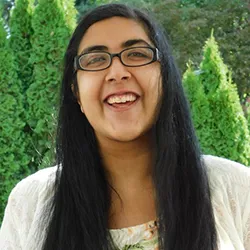
SOUMYA TADEPALLI (she/her) is a theater maker, comedian, and arts administrator based in New York City who currently serves as the Literary Associate and Content Curator at EnActe NYC [a South Asian theater collective dedicated to developing new work]. She also is the curator of South Asians in the Arts, a weekly roundup of performances and events featuring South Asian artists in the city. Previously, Soumya worked as the Public Relations Fellow for the Broadway musical Hell’s Kitchen, as the Development Operations and Database Coordinator at Oregon Ballet Theatre, and as an Artistic and Administrative Intern at The Tank. She is a graduate of Syracuse University’s theater management program and is a recent alum of The Public Theater’s BIPOC Critics Lab.